
When Evil Bunnies Attack: A Festive Guide to XSS Vulnerabilities
The North Pole Has a Problem Picture this: Santa's workshop has gone digital. McSkidy, the brilliant Chief Elf of Cybersecurity, has just rolled out a shiny new secure message portal. Everything's automated, everything's modern, and everything should be perfectly safe. Right? Wrong. The logs are lighting up like a Christmas tree, but not in a good way. Odd messages, suspicious search terms, and even Santa's letters are looking more like JavaScript than jolly correspondence. Someone—or some thing—is trying to mess with McSkidy's portal. And that's where you come in.
ADVENT OF CYBERCYBERSECURITY
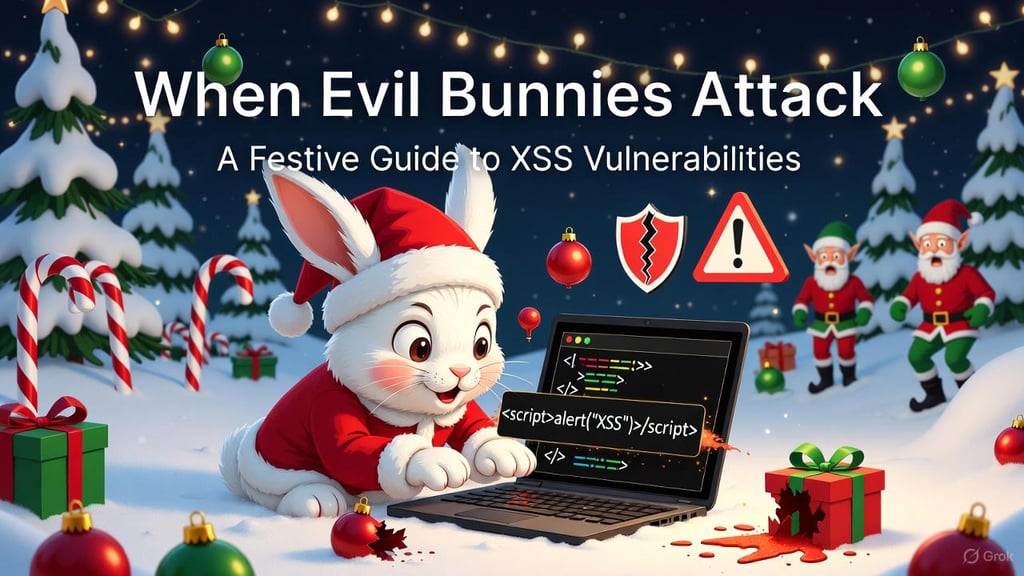
Enter the Villain: Cross-Site Scripting (XSS)
Cross-Site Scripting, or XSS for those of us who can't be bothered with seven syllables, is the gift that keeps on giving—to attackers, anyway. It's a vulnerability that lets malicious users inject code (usually JavaScript) into input fields that other users will see. Think comment sections, search bars, message forms—basically anywhere you can type something and have it displayed back to you or others.
The problem? When websites don't properly validate or escape user input, browsers can't tell the difference between legitimate content and malicious code. It's like inviting a vampire into your home—once you've said "come in," all bets are off.
The Two Flavors of Naughty: Reflected vs. Stored XSS
Reflected XSS: The Drive-By Attack
Imagine you're searching for the perfect gift on an online toy store. You type in "teddy bear" and get lovely results. But then your "friend" sends you this link:
https://trygiftme.thm/search?term=<script>alert("SURPRISE!")</script>
Click that link, and boom—the code executes immediately. It's reflected right back at you like a malicious boomerang. The attack is temporary, targeted, and usually delivered via phishing. It's the XSS equivalent of a prank phone call: annoying, potentially dangerous, but it only affects you when you fall for it.
The Impact: Attackers can perform actions as you, view your information, or modify what you see. It's identity theft with extra steps.
Stored XSS: The Ticking Time Bomb
Now here's where things get spicy. Stored XSS is the "set it and forget it" attack method. Instead of targeting one person with a malicious link, attackers inject their code into a website's database—think comment sections, user profiles, or message boards.
Let's say you're running a product review site. Normal Tony leaves a normal review:
This gift set my carpet on fire but my kid loved it!
But Evil Tony has other plans:
<script>alert("Got ya!")</script> This gift set my carpet on fire but my kid loved it!
If your site doesn't sanitize input, Evil Tony's script gets saved to the database. Now, every single person who views that review triggers the malicious code. It's no longer about tricking one person—it's about poisoning the well.
The Impact:
Steal session cookies (hello, account hijacking!)
Deploy fake login popups (phishing on steroids)
Deface entire pages (digital vandalism)
Turn victims into unwitting attackers themselves
Testing McSkidy's Portal (Ethically, Of Course)
When we tested the message portal, we started simple:
<script>alert('Reflected Meow Meow')</script>
Dropped that into the search bar, hit enter, and—bingo—an alert box popped up. The site was interpreting our "search query" as executable code instead of plain text. That's reflected XSS confirmed.
But wait, there's more! The portal also has a message submission form. What happens if we inject our payload there?
<script>alert('Stored Meow Meow')</script>
This time, the alert appears not just once, but every single time anyone loads the page. The malicious code is now stored in the database, executing automatically for every visitor. That's stored XSS, and it's far more dangerous.
Building Better Defenses
So how do we stop these evil bunnies (or hackers, or whatever) from turning our websites into playgrounds of chaos?
1. Treat User Input Like a Suspicious Package
Never trust user input. Ever. It doesn't matter if it's coming from your grandmother—sanitize and validate everything.
2. Use Safe Rendering Methods
Instead of innerHTML (which happily accepts and renders any HTML/JavaScript you throw at it), use textContent. It treats everything as text, no interpretation, no execution. Boring? Yes. Safe? Absolutely.
3. Lock Down Your Cookies
Set your session cookies with:
HttpOnly (JavaScript can't touch them)
Secure (only sent over HTTPS)
SameSite (prevents cross-site shenanigans)
Think of these as the deadbolts on your cookie jar.
4. Sanitize and Encode Everything
Sometimes you need to accept HTML input—like when users want to format their comments with bold text or links. Fine. But sanitize it first. Remove or escape anything that could be interpreted as executable code. Keep the safe stuff (like basic formatting), toss the dangerous stuff (like <script> tags and event handlers).
The Moral of the Story
XSS vulnerabilities are like leaving your front door unlocked in a neighborhood full of mischievous elves. Sure, most visitors might be friendly, but it only takes one troublemaker to cause chaos.
The good news? With proper input validation, output encoding, and secure coding practices, you can slam that door shut. McSkidy's portal got its wake-up call, and the team is now hardening the site to prevent future attacks.
Remember: in cybersecurity, paranoia isn't a bug—it's a feature. Trust nothing, validate everything, and always assume someone, somewhere, is trying to inject a script where it doesn't belong.
Stay safe out there, and may your input fields forever remain sanitized!
Want to learn more? Check out OWASP's resources on XSS prevention, or dive into PortSwigger's fantastic XSS cheat sheet. Your future self (and your users) will thank you.