
Malware Mayhem in Wareville: A SOC Elf's Tale
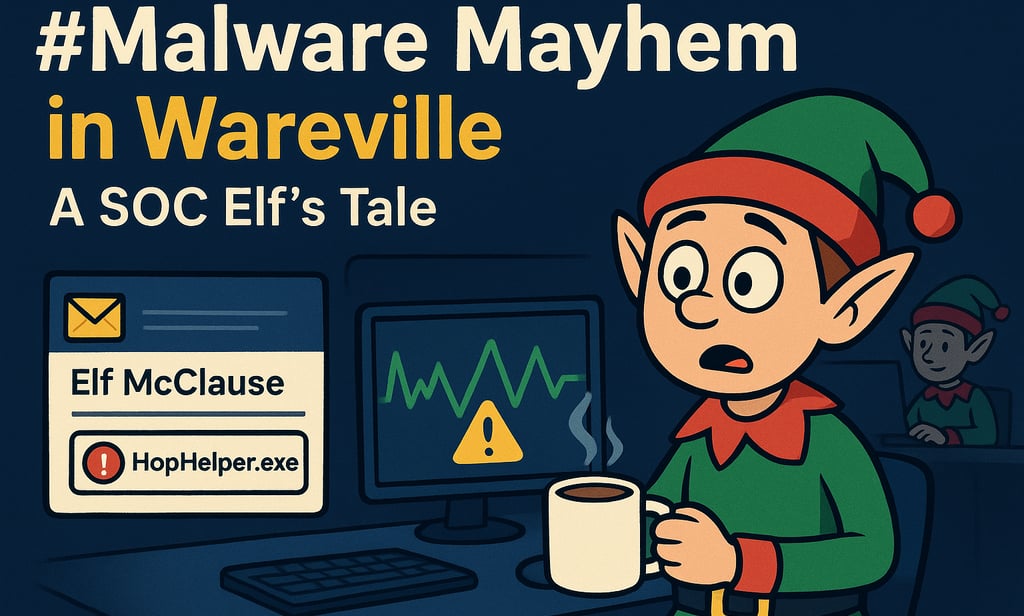
When Your Boss Emails You at 3 AM (And It's Not Actually Your Boss) Picture this: It's 3 AM in Wareville. The town is sleeping peacefully, blissfully unaware of the digital drama about to unfold. But in the cozy confines of The Best Festival Company's Security Operations Center, the elves are wide awake, clutching mugs of hot cocoa, eyes glued to their monitoring dashboards. Then it happens. Ding! An email from Elf McClause, Head of Elf Affairs, lands in everyone's inbox simultaneously. "Why is Elf McClause working at 3 AM?" screams one particularly astute elf from the back. Plot twist: he shouldn't be. And that's when our hero, Elf McBlue, springs into action.
ADVENT OF CYBERCYBERSECURITY
The Suspicious Case of HopHelper.exe
The email promised revolutionary team scheduling software. The attachment? A file called HopHelper.exe. Now, if you're thinking "that sounds suspicious," you're channeling your inner Elf McBlue. Years of SOC experience have taught this wise elf one golden rule: Never download "out of the blue" executables.
Armed with their malware investigation toolkit and possibly another mug of cocoa, Elf McBlue began the investigation that would make this the most exciting 3 AM shift in Wareville history.
Welcome to the Sandbox (No Beach Required)
Here's where things get technical and fascinating. Malware analysts like Elf McBlue use something called a "sandbox" to examine suspicious files. Think of it as a digital playpen where malware can throw its temper tantrum without breaking anything important.
The golden rule? Never run dangerous applications on devices you care about. It's like testing if a milk carton has gone bad—you don't do it by making pancakes with it first.
The Two-Pronged Attack: Static vs. Dynamic Analysis
Static Analysis is like being a detective at a crime scene before anyone's touched anything. You examine the file without running it, looking for:
Unique fingerprints (checksums)
Hidden messages (strings)
Suspicious tools it might use (imports)
Fake disguises (resources pretending to be innocent icons)
Dynamic Analysis is when you actually let the suspect loose in your controlled environment and watch what chaos unfolds. Will it try to hide in the registry? Make suspicious phone calls to remote servers? Leave incriminating evidence everywhere?
The Investigation Unfolds
Using tools like PeStudio, Elf McBlue started with static analysis. The SHA256 checksum revealed this wasn't just any executable—it had a unique digital fingerprint that could be tracked. Buried in the strings (readable text within the file) was even a flag, like a criminal leaving their calling card at the scene.
But the real magic happened during dynamic analysis. Using Regshot, Elf McBlue took a "before" snapshot of the system registry, executed the malware in the sandbox (cue dramatic music), and then took an "after" snapshot. The differences? Damning evidence of the malware trying to establish persistence—basically trying to move into the system permanently like a really unwanted houseguest.
Process Monitor (ProcMon) revealed even more secrets. The malware wasn't just sitting idle; it was actively communicating, making TCP connections, writing registry keys, and generally causing digital mayhem. Through careful filtering of thousands of system events, the malware's true colors emerged.
The Lesson from Wareville
What makes this tale particularly delightful is how it mirrors real-world cyber security. Attackers don't need sophisticated zero-day exploits when they can simply send an email at 3 AM claiming to be from management. Social engineering combined with malicious executables remains one of the most effective attack vectors.
But here's the inspiring part: with the right training, tools, and a healthy dose of suspicion (thanks, Elf McBlue!), these attacks can be detected, analyzed, and defended against. Every piece of information gathered—from registry modifications to network protocols—becomes intelligence that can protect not just one system, but entire organizations.
The Takeaway
Whether you're an elf in Wareville or a human in the real world, the lessons remain the same:
Question suspicious emails, especially at odd hours
Never execute unknown attachments on production systems
Use sandboxes for investigating potentially malicious files
Document everything during your investigation
Share threat intelligence with your team
And perhaps most importantly: keep that hot cocoa handy. Malware doesn't care what time it is, and neither should your defenses.
Stay vigilant, stay caffeinated, and remember: in the world of cybersecurity, paranoia isn't a bug—it's a feature.
Inspired by the adventures of Elf McBlue and the SOC team at The Best Festival Company. No elves were harmed in the making of this malware analysis, though several sandboxes may need reformatting.